the answer to your doubt is It can't stop them the spammers and bad people from using your images but you can stop to some extent. Because most of the spammers want bulk amount of images downloaded which are not watermarked and then use them for their work,as they don't want to waste time on editing your images!. This way we can stop the spammers from using the images to some extent. Here we are going to show you how to watermark your Facebook images with DMCA
DMCA is the short-form of Digital Millennium Copyright Act. DMCA helps the original copyrighted holder to protect their work from being used by the other people.The work can include blog content, videos, pictures, websites, games. DMCA also lets you to file a case in complete legal way against those who copied your work!
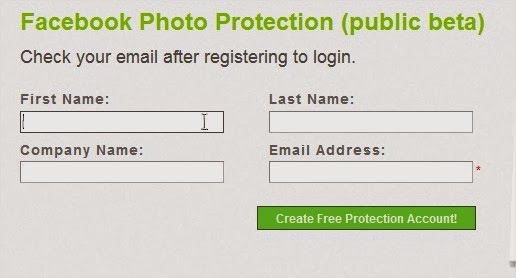
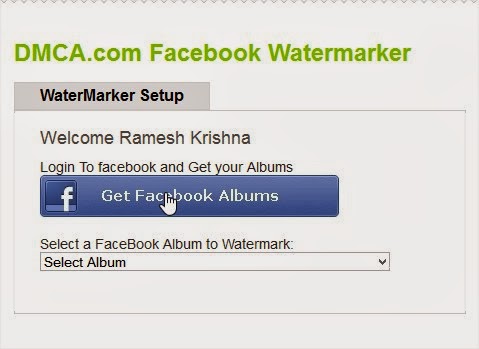
After completion of registration Facebook watermark tool from Here. Now Authorize DMCA to get the images from your Facebook profile by clicking on "Get Facebook Albums'
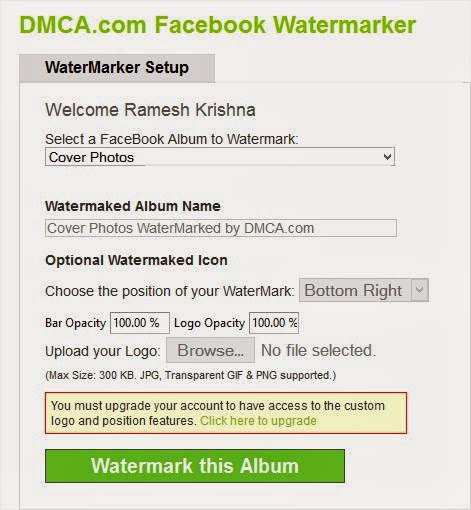
After grating the access to get the images, select the albums from dropbox menu.
Hit on Watermark this Album.and you are done. that's it all your images will be watermarked with DMCA logo. In order to remove the DMCA logo and add your own logo you need to upgrade your plan to monthly to yearly.
- See more at: http://www.alltechtricks.com/2013/11/Protect-my-facebook-pics.html#sthash.9wgFJqUp.dpuf
The
only thing we can do to protect our images on Facebook is setting the
album privacy to only our friends!. But what about the people who had so
many people as their friends! Watermark is a simple way to stop others
from using your images for bad things. - See more at:
http://www.alltechtricks.com/2013/11/Protect-my-facebook-pics.html#sthash.9wgFJqUp.dpufd
The
only thing we can do to protect our images on Facebook is setting the
album privacy to only our friends!. But what about the people who had so
many people as their friends! Watermark is a simple way to stop others
from using your images for bad things. - See more at:
http://www.alltechtricks.com/2013/11/Protect-my-facebook-pics.html#sthash.9wgFJqUp.dpuf
The
only thing we can do to protect our images on Facebook is setting the
album privacy to only our friends!. But what about the people who had so
many people as their friends! Watermark is a simple way to stop others
from using your images for bad things. - See more at:
http://www.alltechtricks.com/2013/11/Protect-my-facebook-pics.html#sthash.9wgFJqUp.dpuf
The
only thing we can do to protect our images on Facebook is setting the
album privacy to only our friends!. But what about the people who had so
many people as their friends! Watermark is a simple way to stop others
from using your images for bad things. - See more at:
http://www.alltechtricks.com/2013/11/Protect-my-facebook-pics.html#sthash.9wgFJqUp.dpuf
The
only thing we can do to protect our images on Facebook is setting the
album privacy to only our friends!. But what about the people who had so
many people as their friends! Watermark is a simple way to stop others
from using your images for bad things. - See more at:
http://www.alltechtricks.com/2013/11/Protect-my-facebook-pics.html#sthash.9wgFJqUp.dpuf
Facebook has lots of interesting videos but no direct option to just
download what you're watching. However, with just a couple of clicks,
you can often download those videos and save them for future
entertainment or posterity. In this article, you'll learn a couple of
ways to download Facebook videos for free using a third-party. Just
follow these instructions.
Find a video you like. Most likely, your current news feed will contain several to experiment with.
Many of the videos posted on Facebook are hosted by YouTube, and
simply shared on Facebook. To grab those, you'll need to download them directly from YouTube. (The site hosting the video will generally be embedded in the video frame.)
A video that is actually hosted by Facebook won’t credit any other website.
2
Grab the link. To get the link to a Facebook video, right-click on the name of the video and select Copy link address or Copy link location.
3
Go to FBDOWN.net ( http://fbdown.net ) OR FacebookVideoz.Com ( http://facebookvideoz.com
) . Those are 2 websites that are very simple and straightforward, and
lets you pull in any Facebook-hosted video, where you can share it back
to Facebook, tweet it, embed it in your blog or website, or download it.
Like YouTube, it even has a provision for making comments. The link is
provided below.
4
Paste the URL. At the top of the page, click in the Enter the video link field, and paste the link URL into that field.
5
Click Download. A link to the video you selected as well as new links will appear in a new page containing HD (High Definition) or SD Video.
6
Save the video. Right-click Download Video in High Quality or Download Video in Low Qualityand select Save As. This will open a dialog box asking you where you’d like to save the mp4.
Open the video in a new window. You can also left-click Download
this Video, which will open a new tab showing the video. Right-clicking
on the video from here will also give you the option to save, but only
if you have Quick Time Pro.
7
Choose a download name and location and click Save.
**Mobile monthly active users: 751 Million, a 54% increase year-over-year.
**Ad revenue: $1.25 billion
**Mobile ad revenue was $375 million. That's 30% of total revenues, up from 23% last quarter. That's better than the $320 million JP Morgan analyst Douglas Anmuth was hoping for.
**March DAU: 665 million.
Two things we were looking for in particular were…
Usage stats. 665 million DAUs in March is a slight uptick over 618 million in Q4.
Facebook hosted an earnings call to go over the numbers at 5 p.m. eastern today.
the Facebook guy, right? That's him. Mark "Zuck" Zuckerberg, chairman and CEO of Facebook, Inc, and the first person to make several billion dollars from a website with a "poke" function.
What's he doing now? Poking his way into politics. Zuck has got together with a group of other top Silicon Valley executives to create anissues-based political action committee focusing – for the moment, at least – on liberalising the US visa and immigration systems.
And why do they want to reform immigration? They're a group of top executives.
Ah. Because it's costing them money? Pretty much. Earlier this month, Zuck and a gang of 99 other chief execs, including Yahoo CEO Marissa Mayer, co-wrote a letter to President Obama calling the current immigration system "outdated and inefficient". They said highly skilled immigrant workers were often unable to obtain permanent visas and forced to leave the country – and others were so put off by the system they wouldn't even bother coming to the US in the first place.
And did Obama listen? He did. He has also consistently said the same thing. In fact, there are two bills in the Senate already aimed at addressing precisely those problems. But Zucky B – as he's known to no one – felt a committee was in order anyway.
So who has he got on this committee? A bipartisan team of political consultants, with – shock horror – at least two Republican strategists on it.
You don't mean …? Perhaps.
Mark Zuckerberg isn't …? He might be. He also held a fundraiser at his home in Palo Alto earlier this year for Governor Chris Christie of New Jersey.
Who is …? Yup. A Republican. And one with an eye on running for the White House.
Shocking. I know, right? Who would have thought a billionaire with a controversial approach to privacy would have rightwing sympathies?
Do say: "I liked him better when he just ran that poking service."
Don't say: "I would 'unlike' him but I never 'liked' him anyway."
In this article I’ll share what Facebook’s Graph Search is, how it works and how it fits your marketing strategy.
What Is Graph Search?
Graph Search is Facebook’s latest revision to the search feature that helps users find connections to people and places that have always existed in the graph.
In a sense, it’s a clean interface into the breadth of Facebook data that people have entered into Facebook, but contextualized to each user.
Watch this video introducing Facebook Graph Search.
Think about that for a moment. Facebook’s new Graph Search serves up personalized search results in real time based on a person’s graph, and it does this for over 1 billion people.
Kudos to the Facebook engineering team for this major achievement.
As you’ll see below, it’s early for Graph Search. The features and use cases haven’t been fully fleshed out. And Graph Search is still in a very limited beta program.
But this first version gives us clues about how Facebook may evolve and the strengths on which they’ll try to build.
Walkthrough of Facebook Graph Search
Let’s start with a search about one of my favorite foods—bacon!
In the screenshot below, you can see a search for “bacon” in the old Facebook search format. Search results provide a listing of Pages, People and Places with the search term “bacon.”
A search query for “bacon” in the existing, original Facebook Search format.
This is helpful if you’re looking for something that includes “bacon” in the title of the Page, a person/profile or a place. But it doesn’t give you any insight into all of the other places on Facebook where there may be relevant social context to bacon. Who likes it? Who has commented on it? What else can the social graph tell us about friends and bacon? The original Facebook search does nothing for you if you want to know these things.
This is dumb search, in essence, not unlike what we experienced with the first search engines in the late 1990s.
Facebook’s Graph Search
Now let’s walk through a Graph Search for bacon. Here’s what you see when you use a semantic search for “bacon” on Facebook.
Facebook Graph Search results for “bacon.”
Note that I’m provided with suggestions related to the search term I’ve entered. You can get to the Facebook Page for bacon, the Interest, the People who like bacon, My Friends who like bacon, photos of bacon, web searches of bacon and bacon wrapped water chestnuts.
Who knew?
To navigate to one of the semantic search options, you can use the tab key to go a level deeper to find the people or Pages that you want.
This is really Facebook’s first foray into what is known as semantic search. Put simply,semantic search is a concept referring to technologies that make a search respond to what the user enters to try to better understand what the user wants to know.
Think of it as interaction between the search technology and the user to provide better search results. Search engines have done this for several years now when they fill out your search box for you and provide suggested keywords. It’s employing technology to get you closer to your answer without your direct intervention.
Semantic search is a relatively new technology, so you have to accept this as an ongoing evolution and not a revolution. Semantic search is getting better every day, but has a long way to go to be precise based on your interests and behaviors.
Search for Facebook Interest Pages
Here’s a look at the bacon Interest Page to see if there are any changes. Sure enough, there are. You get additional information on the interest provided byWikipedia. OK, that’s useful.
Screenshot of the bacon Interest Page.
Additionally, you can immediately see who among my friends likes bacon, as well as photos that are captioned with the word bacon. This was discoverable before, but not nearly as easily. Overall, the Interest Page layout is different and improved in order to make social context clearer to the user.
You may notice as well that at the top of the screen, the URL carries a ?sid=0.002…code. The implication here is that Facebook is tracking how people use Graph Search in order to improve the product.
Note the code at the end of the URL for this search.
Additionally, the Interest Page includes posts by friends about bacon and Related Pages, which are in the screenshot below. It’s interesting that these posts are not individually mined by Facebook and made searchable, although I suspect that’s a forthcoming feature for Facebook’s Graph Search.
Finally, wistful posts from my friends about bacon. People just love bacon.
Search with the “Friends Who Like” Option
Continuing on in the semantic search, there’s an option in the Search Bar for “My Friends who like bacon.”
In the screenshot below, you’ll see a long list of my surely cholesterol-challengedFriends who like bacon.
My friends who like bacon, provided by Facebook’s Graph Search.
You’ll see a long list with the ability to refine your search on the right side of the screen. This appears to be sorted by the number of friends and subscribers for these items.
At the top of the list is Brian Carter, a fellow author and speaker. Interesting that I don’t interact with him all that much, but he’s at the top of my list. I’d have expected this to be sorted by the number of interactions we’ve had rather than social reach. But that’s something Facebook can tweak later.
In the right-hand sidebar, you can narrow your search further to find specifically who you’re looking for. Additionally, at the bottom right of the screen is a link to “More Pages they like.”
Curiosity kills me, so I decide to take a gander at that one. Not a lot of surprises here. As you can see, I have supportive friends who like my book, Austin, eating healthy and technology. Yep. Sounds about right.
This is a handy tool to identify Pages you should like. Interestingly, these are not sorted by the number of Page likes, but rather the number of friends who like each Page.
Pages liked by my male friends who also like bacon.
If I go back to the top of the screen and click the search box, I get another level of friends who enjoy bacon. Now Facebook’s semantic search technology combines your groups and affiliations with your search term, in this case “bacon.” Presumably this is to give you the best opportunity to find people with intersecting interests and commonalities. Clever.
I use the feature to find a friend or two in each category. I wouldn’t necessarily call this “intelligent,” but if it were hooked up to Siri on my iPhone, I’d be simultaneously amazed and creeped out by now.
Next level of Facebook’s semantic Graph Search—suggesting I look at people from my groups and past affiliations who also like bacon.
In the “bacon” search results in the image below, you’ll notice “Photos of Bacon.” When you click the search box here, you are again presented with additional semantic options. In this case it’s “Photos of Bacon taken in Austin, Texas.”
Facebook’s Graph Search providing another level of semantic context beyond Photos of Bacon.
This is designed to get you closer to the search result you want. It reads from your profile to see your location. In this case I’m in Austin, TX and Graph Search tries to match your search term to something that is likely relevant to you.
There are not a lot of options here for this semantic search of Photos of Bacon, but remember this is a new technology that will improve over time and will include more data as time goes on.
Search to Find a Local Business
Are you hungry for lunch and craving a hot dog? Let’s use Facebook to find something.
A search for “hot dogs” gives the following results:
A Facebook Page for a local Austin restaurant
A restaurant in Lesage, WV
The Place Page
The Hot Dogs Interest Page
Hot Dogs from Baja California
A search for “hot dogs” yields disappointing local results.
It’s curious why these particular search results for “hot dogs” come up, and none of the thousands of other places between Austin and Lesage, WV. Do hot dog restaurants not market themselves on Facebook? Doubtful. And if you’re a marketer for a company selling hot dogs, how do you get on this list? Can you even break into Graph Search?
I’m surprised that chains that sell hot dogs, such as Sonic or Dairy Queen, are not listed here while Hillbilly Hot Dogs is. This isn’t terribly impressive, but I’ll chalk this up to necessary cleanup for the Graph Search beta.
Let’s investigate the only viable option for me here—Frank Hot Dogs. The first thing that jumps out is the redesigned Facebook Page that really looks more like a Yelp orGoogle local business listing. Address, website and map are all prominently displayed, as is the social context of my friend who likes Frank.
Frank Hot Dogs in Austin, TX.
Below the fold is also a listing of other local businesses near Frank, where you can presumably walk off your lunch. Notice in the image below that the listings in the “Places Near Frank” are sorted by the number of likes each local business has.
It’s interesting that social proof (in the form of a like) is used to build out your choices, even though Frank is in downtown Austin and is surrounded by other options.
Places near Frank Hot Dogs.
Search for Hot Topics and What Friends Are Saying
One final scenario here—let’s look at how Graph Search can help us find conversations on Facebook that would interest us.
Apple has been in the news a lot lately with earnings announcements, popular products and conjecture about the company as a stock investment.
Here’s what Facebook has to offer for a search of “Apple”: an Interest, a Sponsored app (interesting), Applebee’s, Apple for Education (?), the Apple Store and Apple as a Place.
Here’s a Graph Search for “Apple.”
When you click Apple, Inc., you get a new set of semantic results. This is significantly better—as I have friends who work at Apple, I was expecting to see that. But it’s several levels down and requires you to go through several steps to find it.
So usability is an issue, and in the efforts to create something “semantic,” Facebook might have made it somewhat difficult to navigate, at least today.
Also note that there is no mention of status updates or comments that people have made about Apple. I’d really like to see that in one place.
Tired of seeing every inane detail of yours friends lives pop up in that annoying Facebook sidebar ? Well apparently Facebook was too as the redesign announced yesterday eliminates Ticker for some, and banishes it to the bottom of the left Chat sidebar as a one-story tall blip for others. The real-time Ticker feed launched 2011 that’s best known for outing your friends as Britney Spears fans.
Facebook seemed well aware that many people disliked the “creeper feed”, as some called it. A while back it gave people the option to minimize the Ticker. Now that valuable screen real-estate can be filled with something people actually want — a little menu for opening up specially dedicated news feeds for photos, music, and more.
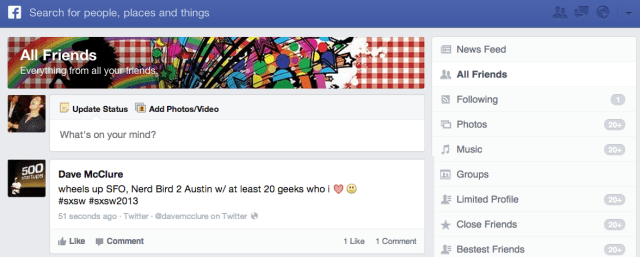
Those include Ticker’s replacement, the All Friends feed. It’s a quieter real-time feed of everything your friends share, which you can choose to view rather than be forced to have cluttering your home page. It doesn’t have the TMI over-sharing feel of Ticker, though, as it cuts out minor stories about status updates and photos your friends liked.
Update: Facebook didn’t kill the Ticker entirely, as we originally said. It’s testing different versions of the redesign. Some kill off Ticker entirely. Some show it as a tiny, one-story tall add-on to the bottom of the chat buddy list in the sidebar. Some viewport / screen resolution sizes have it, some don’t, and some people have it defaulted off, while some have it defaulted on.

If you really love Ticker, when you get the new design you can scroll to the very bottom of your left sidebar to check if you have it. If you do, you can even turn it off with an option inside the ‘gear’ button.
Ticker was designed to keep the news feed feeling fresh, and show you what friends were doing in apps like Spotify and the Wall Street Journal news reader. But it turns out those random tidbits don’t mean much. They’re much more interesting when combined to show “5 of your friends listened to this musician / read this article”. Facebook hopes aggregated stories about those trends and the option to view different streams will keep the news feed from getting boring